Corrosion Protection for Steel Structures in India: Methods & Best Practices
Corrosion Protection for Steel Structures in India: Methods & Best Practices
Corrosion causes billions in damage annually to Indian steel structures. India's diverse climate—coastal humidity in Mumbai/Chennai, industrial pollution in steel cities, monsoon rains, and temperature extremes—demands systematic corrosion protection strategies. With 25+ years protecting 20,000+ tonnes of Indian steel, here's our proven approach.
Understanding Corrosion in India's Climate
Corrosion Risk Zones in India
Coastal Areas (Mumbai, Chennai, Kolkata, Visakhapatnam):
- High humidity + salt spray = aggressive environment per ISO 19840 C4 category
- Expected unprotected steel loss: 10-15 mm depth/year
- Design life requirement: 20-25 years typical
Industrial Regions (Delhi NCR, Pune, Hyderabad, Gujarat):
- Industrial pollution + moderate humidity = ISO 19840 C3 category
- Expected unprotected loss: 5-8 mm depth/year
- Design life: 15-20 years typical
Rural/Urban Non-Industrial (most Indian cities):
- Moderate humidity, lower pollution = ISO 19840 C2 category
- Expected unprotected loss: 2-3 mm depth/year
- Design life: 20-25 years with maintenance
Underground/Buried Structures:
- Soil corrosivity varies (pH, moisture, salt content)
- Requires cathodic protection + coating system per IS 9395
Corrosion Types
Uniform Corrosion: Even surface rusting (most common, easiest to prevent)
Pitting: Localized deep holes (dangerous; hard to detect without inspection)
Crevice Corrosion: At gaps, joints, under bolt heads (common in poorly designed connections)
Galvanic Corrosion: Dissimilar metals in contact (steel bolts in aluminum structure)
Stress Corrosion: Tensile stress + corrosive environment (critical in high-stress members)
Corrosion Protection Methods
1. Protective Coatings (Most Common in India)
Hot-Dip Galvanizing (HDG)
Process: Steel dipped in molten zinc (~840°F/450°C) per ASTM A123 / IS 2629
Advantages:
- Service life per ISO 14713-1 corrosivity tables:
- C2 (rural/urban India): 25-50 years typical
- C3 (industrial India): 15-25 years typical
- C4 (coastal India): 5-15 years typical
- Uniform coverage including hard-to-reach areas
- Self-healing at cut edges (zinc sacrificially protects exposed steel)
- Minimal maintenance under normal service
Limitations:
- Size restrictions (tanks typically 12m x 1.5m x 2.5m)
- Cannot galvanize very large structures
- Initial cost higher than paint (₹50-70K/tonne)
- Possible distortion in thin sections
Use in India: ROBs, railway bridges, outdoor structures where low maintenance critical
Paint Coating Systems
For Mild Environment (C2: Rural/Urban Non-Industrial):
- Primer: Zinc phosphate (40-50 µm)
- Intermediate: Epoxy (60-80 µm)
- Topcoat: Polyurethane (40-50 µm)
- Total DFT: 150-200 µm per ISO 19840
- Design life: 7-10 years
- Cost: ₹100-150/sq.m (excluding surface prep)
For Moderate Environment (C3: Industrial/Urban India):
- Primer: Zinc-rich epoxy (60-80 µm)
- Intermediate: High-build epoxy (80-100 µm)
- Topcoat: Polyurethane (60-80 µm)
- Total DFT: 200-260 µm per ISO 19840
- Design life: 15-20 years with maintenance
- Cost: ₹200-300/sq.m
For Severe Environment (C4: Coastal India—Mumbai, Chennai, Kolkata):
- Primer: Inorganic zinc silicate (80-100 µm)
- Intermediate: High-build epoxy (150-200 µm)
- Topcoat: Aliphatic polyurethane (60-80 µm)
- Total DFT: 300-400 µm per ISO 19840
- Design life: 20-25 years with maintenance
- Cost: ₹350-500/sq.m
2. Surface Preparation (Critical Foundation)
Importance: Coating life is 70% dependent on surface prep quality
Standards:
- ISO 8501-1: Visual standards for rust grades and blast-cleaning
- ISO 14644: Cleanliness levels
Cleaning Grades:
Sa 2.5 (Near-white blast cleaning):
- Mill scale, rust, and most foreign matter removed
- 95% clean to metallic appearance
- Standard requirement for industrial/bridge coatings per IS 9361:2011
- Cost: Base cost for surface prep
Sa 3 (White metal blast cleaning):
- 100% clean to metallic appearance
- Required for:
- Immersion/submerged service
- Severe corrosive environments (coastal C4)
- Maximum coating life requirement
- Cost: +15-20% vs. Sa 2.5
Surface Roughness:
- Requirement: 50-100 µm (Rz) per ISO 8501-1
- Too smooth: Poor coating adhesion
- Too rough: Coating peak coverage issues
- Measurement: Via comparator or profilometer
Pre-painting Cleanliness Tests:
- Dust test: Tape pressed on surface (no visible dust acceptable)
- Chloride test: <50 mg/m² on surface (critical for coastal areas)
- Water-soluble salts: <20 mg/m² for critical applications
3. Application Best Practices
Environmental Conditions (critical for Indian weather):
DO NOT PAINT if:
- Steel temperature <3°C above dew point (condensation causes failure)
- Relative humidity >85% (monsoon season challenge in coastal regions)
- Rain forecast within coating cure time (paint needs dry conditions)
- Temperature <5°C or >40°C (affects curing; check product specs)
- Windy conditions >8 m/s (dust contamination)
Environmental Monitoring:
- Record temperature, humidity, dew point before application
- Use instruments to verify conditions
- Document in QA records (required by ISO 9001 and client specs)
Application Methods:
Brush/Roller:
- Use: Touch-up, small areas, intricate sections
- Film build: 30-50 µm per coat
- Waste: Minimal (5%)
Conventional Air Spray:
- Use: General-purpose, faster application
- Film build: 40-80 µm per coat
- Waste: High (30-40% overspray)
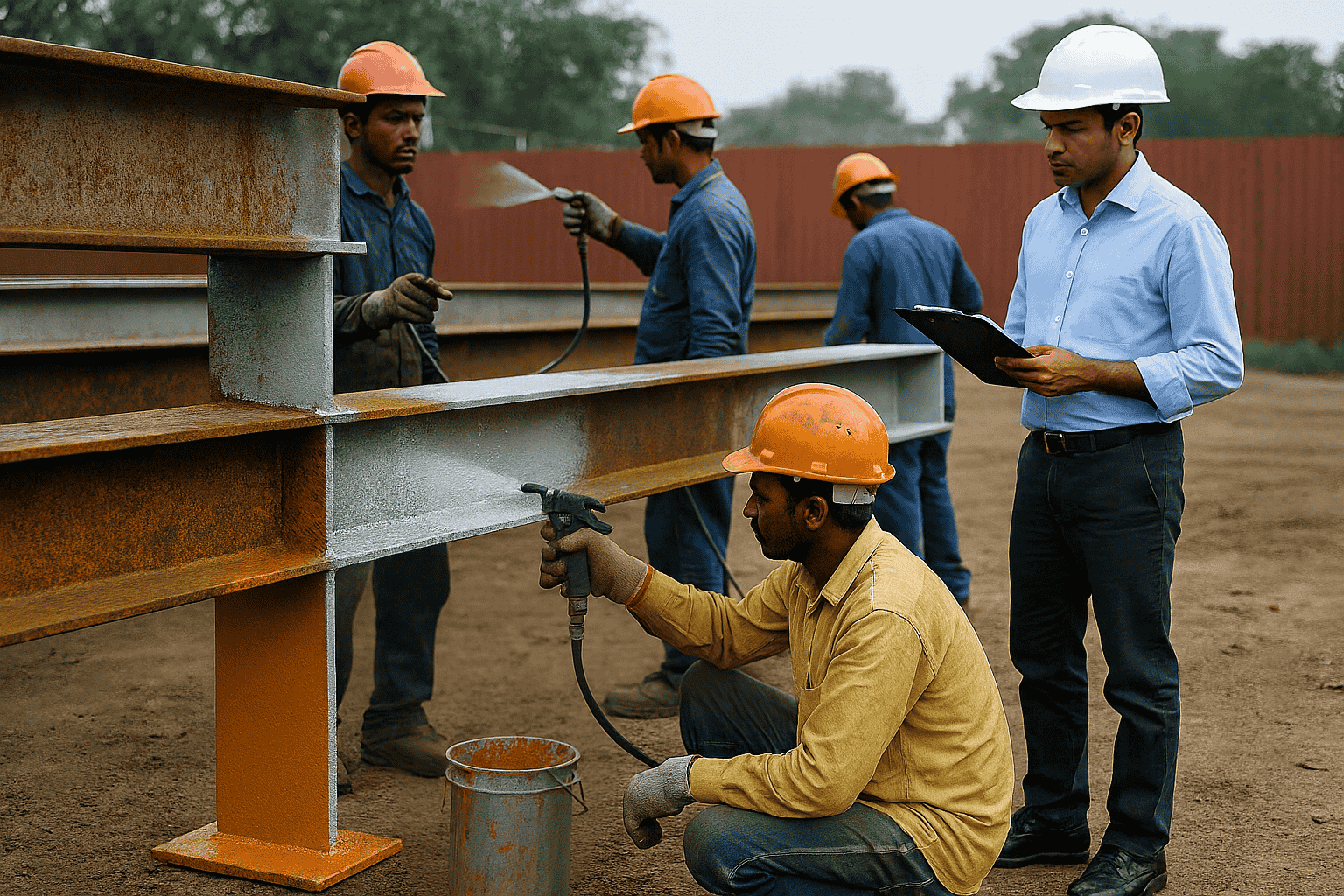
Airless Spray:
- Use: Large surfaces, high-build coatings
- Film build: 100-250 µm per coat
- Waste: Moderate (15-25%)
- Better for thick coatings required in C3/C4 Indian environments
4. Quality Control During Application
Dry Film Thickness (DFT) per ISO 19840:
Measurement:
- Frequency: Every 10 sq. meters minimum (per ISO 19840 / project spec)
- Tool: Electromagnetic gauge calibrated per ISO 2808
- Locations: Document specific areas tested
Acceptance:
- Per project specification / ISO 19840 tables
- Typical: 90% of readings within specified range
- Example: If specified 250 µm DFT:
- Minimum acceptable: ~200 µm (per ISO 19840 tolerance tables)
- Maximum acceptable: ~300 µm
- 90% of measurements must fall within this range
Documentation: Complete DFT report with location map, min/max/average readings
Holiday (Pinhole) Detection:
Method: Low-voltage holiday detector per ASTM D5162 or NACE SP0188
- Voltage setting: Per instrument specifications and DFT (typically 67.5V per 25 µm DFT)
- Frequency: Per project ITP (typical: 100% critical areas, 10-25% general)
Repair:
- Mark identified holidays
- Abrade surface with sandpaper
- Apply primer and topcoat to achieve specified DFT
- Re-test affected area
Adhesion Testing:
Cross-cut test (ISO 2409):
- Simple adhesion check
- Classification 0-5 scale
- Acceptance: Grade 0-1 required
Pull-off test (ISO 4624):
- Quantitative measurement (MPa)
- Acceptance: >5 MPa typical
- Frequency: Once per 200 sq. meters or per spec
Maintenance & Inspection for Indian Climate
Inspection Schedule
New structures:
- First year: 6-month intervals
- Years 2-5: Annual inspection
- Years 6+: Annual or biennial per condition
Existing structures in Indian climate:
- Coastal (C4): Every 6 months (monsoon + salt spray acceleration)
- Industrial (C3): Annual inspection
- Rural/Urban (C2): Biennial inspection
What to Inspect (Indian Environmental Factors)
- Coating condition: Blistering (moisture intrusion after monsoon), flaking, chalking
- Rust bloom: Rust staining, indicating coating breakdown
- Water accumulation: Ponding areas (common post-monsoon), poor drainage
- Connections: Bolt corrosion, crevice corrosion (common in ROBs, railway bridges)
- Environmental damage: UV fading (Indian sun intensity), salt staining (coastal), industrial deposits
Assessment Per ISO 4628
Grade coating condition:
- Grade 0: No defects (excellent)
- Grade 1: Very slight defects (<0.05% area)
- Grade 2: Slight defects (0.05-0.5%)
- Grade 3: Moderate defects (0.5-5%) - planning required
- Grade 4: Considerable defects (5-15%) - expedited maintenance needed
- Grade 5: Severe defects (>15%) - immediate action required
Action per Grade:
- Grade 0-2: Continue monitoring
- Grade 3: Schedule maintenance within 12 months
- Grade 4-5: Schedule within 3 months (expedite if safety-critical)
Maintenance Options
Grade 1-2: Cleaning & Touch-up
- Clean with soft brush/cloth
- Spot-prime damaged areas
- Apply single topcoat
- Cost: ₹50-100/sq.m
- Life extension: 3-5 years
Grade 2-3: Overcoating
- Light abrasion with low-grit sandpaper
- Single coat application
- Cost: ₹150-250/sq.m
- Life extension: 5-8 years
Grade 3-4: Spot Repair
- Remove failed coating (sanding/grinding to bare steel)
- Blast to Sa 2.5
- Apply primer + topcoat to specified DFT
- Cost: ₹400-600/sq.m
- Life extension: Full coating life
Grade 4-5: Complete Recoating
- Remove all coatings (blast to Sa 2.5)
- Apply full multi-coat system per specification
- Cost: ₹600-1000/sq.m (including surface prep)
- Result: Like-new structure
Cost-Benefit Analysis for Indian Conditions
Life-Cycle Cost Comparison (25-year analysis, 1000 sq.m structure)
Basic System (2-coat, 150 µm, C2 environment):
- Initial cost: ₹2,40,000
- Maintenance (years 4, 8, 12, 16, 20): 5 x ₹1,50,000 = ₹7,50,000
- Recoating (years 8, 16): 2 x ₹3,00,000 = ₹6,00,000
- Total 25-year cost: ₹15,90,000
Standard System (3-coat, 250 µm, C3 environment):
- Initial cost: ₹3,20,000
- Maintenance (years 10, 18): 2 x ₹1,50,000 = ₹3,00,000
- Recoating (year 15): ₹3,50,000
- Total 25-year cost: ₹9,70,000
Premium System (4-coat, 400 µm, C4 coastal):
- Initial cost: ₹4,20,000
- Maintenance (years 13, 21): 2 x ₹1,00,000 = ₹2,00,000
- Total 25-year cost: ₹6,20,000
Conclusion: Premium coating saves ₹3.3 lakhs over basic system despite higher initial cost.
Special Considerations for Indian Bridge/Infrastructure
Monsoon-Exposed Structures
- Higher DFT specification required (300+ µm vs. 200 µm)
- More frequent maintenance (annual inspection minimum)
- Enhanced drainage design (prevent water pooling)
Coastal Structures (Mumbai, Chennai, Kolkata)
- ISO 19840 C4 classification minimum
- 400+ µm DFT recommended
- Stainless steel fasteners (prevent galvanic corrosion with steel)
- Annual inspection mandatory
- Chemical resistive topcoats (epoxy phenolic or vinyl ester)
Urban Industrial (Delhi NCR, Pune, Ahmedabad)
- ISO 19840 C3 classification
- 250+ µm typical
- Resistant primers for specific industrial atmospheres
- Biennial inspection
Underground/Buried (Pipelines, Piles)
- IS 9395 requirements for underground structures
- Cathodic protection + coating (dual protection)
- Annual inspection of CP system voltage/current
- Coating inspection at annual shutdown/maintenance
Common Mistakes to Avoid
1. Inadequate Surface Preparation
Mistake: Painting over mill scale or rust ("saves money") Result: Coating fails within 6-12 months Fix: Always blast to minimum Sa 2.5 per ISO 8501-1
2. Ignoring Monsoon/Environmental Conditions
Mistake: Painting during high humidity or near dew point Result: Moisture entrapment, poor adhesion, osmotic blistering Fix: Monitor temperature/humidity; use weather monitoring before painting
3. Insufficient DFT
Mistake: Not measuring thickness, visual judgment only Result: Thin spots fail first, premature corrosion Fix: Mandatory DFT measurement every 10 sq.m; document all readings
4. Wrong Coating Selection
Mistake: Using C2-rated paint in coastal C4 environment Result: Rapid failure, expensive recoating Fix: Specify per ISO 19840 corrosivity category and environmental conditions
5. Neglecting Maintenance
Mistake: "Looks okay, skip inspection this year" Result: Spot failures become extensive; expensive complete recoating Fix: Scheduled inspection (frequency per corrosivity category) and preventive maintenance
Conclusion
Effective corrosion protection in India requires:
- Environment assessment: Identify corrosivity category per ISO 19840 (coastal, industrial, rural)
- Proper surface prep: Blast to Sa 2.5 minimum per ISO 8501-1
- Correct coating selection: DFT and system type per environment
- Quality application: Environmental monitoring, DFT verification, holiday detection
- Regular maintenance: Scheduled inspection and preventive touch-up before failures occur
Investment in proper corrosion protection is 1/10th the cost of replacement. The math is simple: spend 15-20% more initially on protection = save 60-70% in life-cycle costs.
Kothari Chemicals Engineering Division has protected 20,000+ tonnes of Indian steel structures with systematic corrosion protection aligned to ISO 19840, IS 9361, and local environmental conditions. Whether coastal, industrial, or rural projects, our approach ensures maximum service life.
Keywords: corrosion protection India, coastal corrosion C4, ISO 19840, hot dip galvanizing India, painting specification India, DFT measurement, surface preparation, steel bridge maintenance, monsoon protection
About Technical Services Team
The Technical Services Team at Kothari Chemicals Engineering Division brings decades of combined experience in steel fabrication, quality assurance, and project management. We're committed to sharing knowledge that helps our industry grow.
.jpg)