
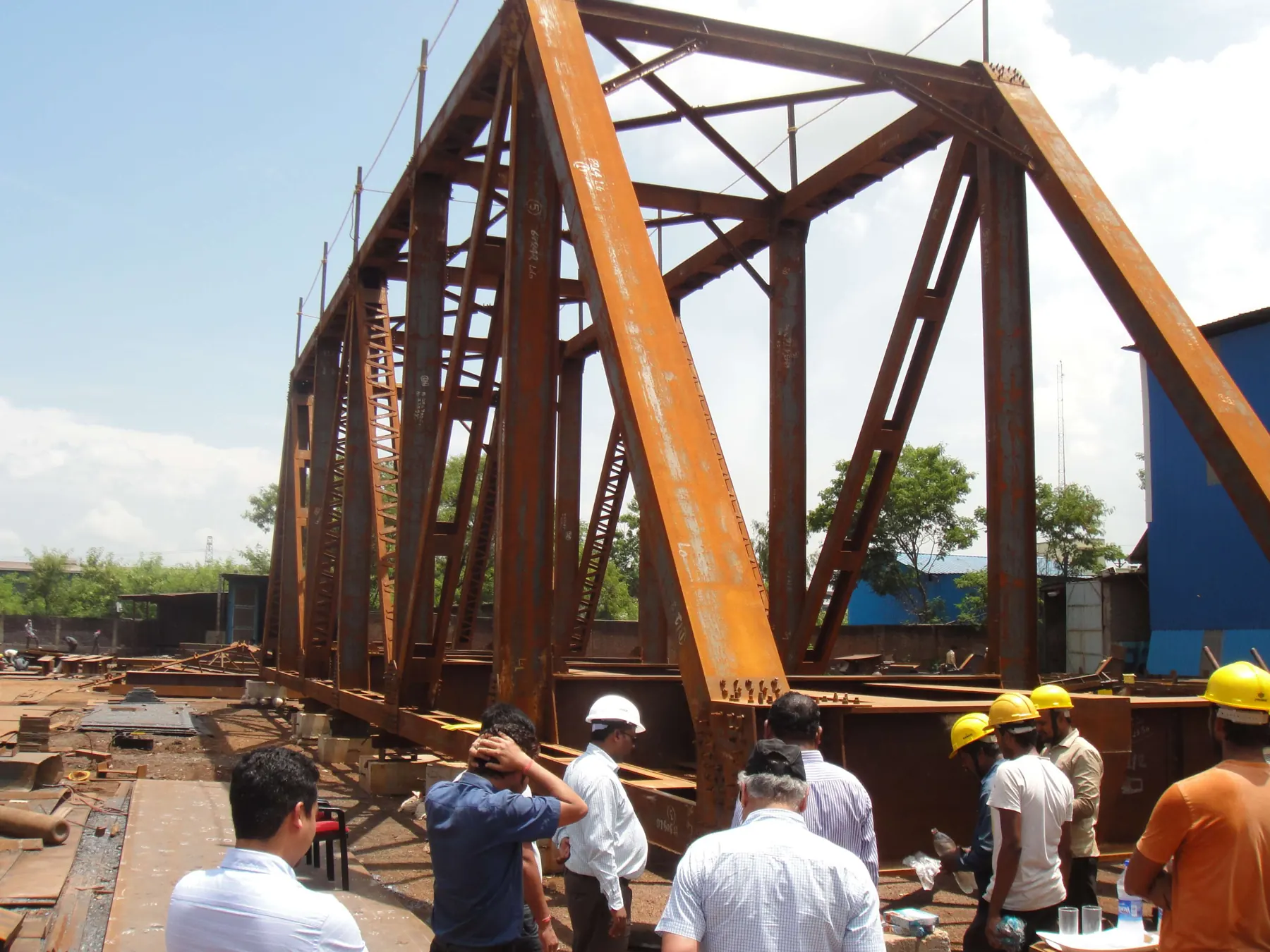
Dye Penetrant and Magnetic Particle Testing for Fabricated Steel: When Each Method Fits
Ultrasonic and radiographic testing find flaws inside a weld or plate. Surface methods find the defects that open at the surface: cracks, laps, and the toe defects that show up after welding, grinding or repair. Two methods do most of this work in steel fabrication, magnetic particle testing and dye penetrant testing. They are not interchangeable, and choosing the wrong one can miss a defect that the drawing required you to find.
Magnetic particle testing (MT or MPI)
Magnetic particle testing works only on ferromagnetic material, which covers carbon and low-alloy structural steel. The part is magnetised, and fine iron particles, applied dry or in a wet suspension, collect where magnetic flux leaks from a discontinuity. Fluorescent particles viewed under ultraviolet light give higher sensitivity than visible particles seen in white light.
It suits:
- Weld toes and fillet welds on structural members
- Surface cracks in plate and section steel
- Repair areas after grinding, before re-welding and again after it
Practical points: the surface must be clean and free of loose scale and heavy coating, the magnetic field must cross the direction of the expected defect, and the part must be demagnetised after testing where residual magnetism would affect later welding or machining.
Dye penetrant testing (DPT or LPT)
Dye penetrant testing finds surface-breaking defects on any non-porous material, including stainless steel and aluminium, which magnetic particle testing cannot inspect. The surface is cleaned, penetrant is applied and left to enter the opening, the excess is removed, and a developer draws the penetrant back out so the indication can be seen.
It suits:
- Non-magnetic materials, such as austenitic stainless steel components
- Welds where the test is required and the surface is not ferromagnetic
- Checks where magnetic particle testing is impractical on the part geometry
Dye penetrant testing is sensitive only to openings that reach the surface. Surface cleanliness, dwell time and temperature all affect the result, so the procedure should state the limits.
Choosing between them
| Question | If yes | If no |
|---|---|---|
| Is the material ferromagnetic? | Magnetic particle testing is an option and is often preferred for speed and sensitivity | Use dye penetrant testing |
| Is the surface coated or galvanised? | Remove the coating locally at the test area before testing | Test the surface as prepared |
| Is the defect expected inside the weld? | Add ultrasonic or radiographic testing, as the drawing requires | Surface methods may be enough |
The contract and the drawing decide which method applies. The test standard then governs the technique and the acceptance criteria. Common references include ISO 9934 for magnetic particle testing, ISO 3452 for penetrant testing, and the code named in the project, such as ASME Section V where the project uses it.
What the report should record
- The method, the written procedure reference and the revision in use
- Material, surface condition and the test area on the drawing
- Technique details: magnetising method and current, particle type, penetrant and developer system, dwell time
- Lighting checks for the viewing conditions
- Each indication, its location, its size and the disposition
Check that the testing personnel hold a current qualification to the level the procedure requires. ISO 9712 is the common framework for personnel certification.
Where surface testing usually pays off
Test the weld toes on the most loaded members, the ends of fillet welds, the areas where a fitting was welded onto a primary member, and any location that was ground to remove a defect. A repair that is not re-tested is an open question on the inspection record.
For how these checks fit into the full inspection plan, see quality control in steel fabrication. For the welding records that sit behind the same joints, see WPS, PQR and welder qualification.
- NDT
- magnetic particle testing
- dye penetrant testing
- weld inspection
- quality control
About Kothari Chemicals (Engineering Division)
The Kothari Chemicals (Engineering Division) at Kothari Chemicals (Engineering Division) writes from day-to-day work in steel fabrication, quality assurance and project execution at the Bhilai works.