
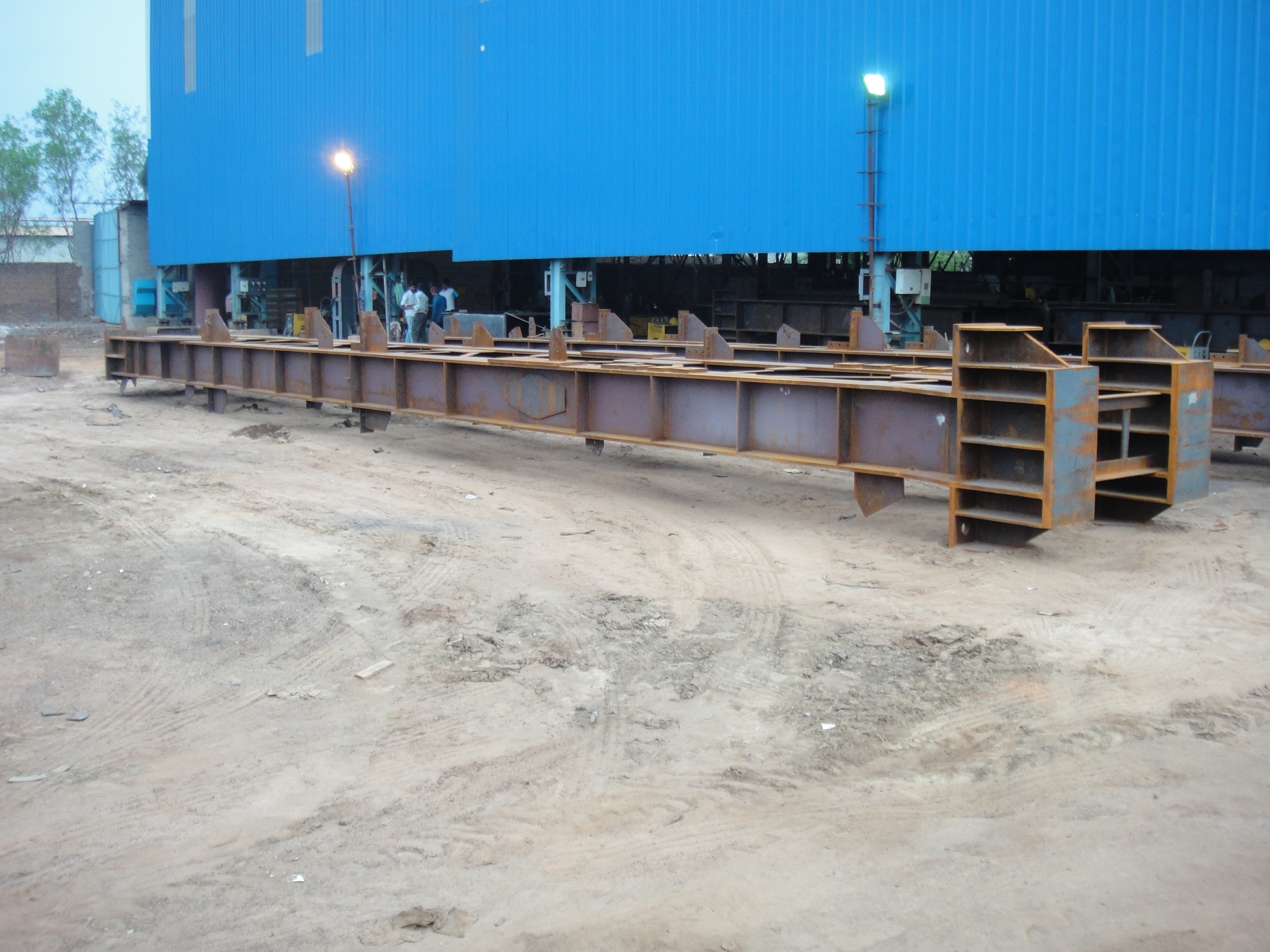
Storage and Protection of Fabricated Steel Before Dispatch
A member that passed inspection can still arrive damaged. Coating is scraped by a sling, a machined face is dented by a stack, a bolt hole is bent by a fork, or a member sits in standing water for a week and rusts at the contact points. Protection between the final inspection and dispatch is part of the fabrication scope, and it is one of the cheapest places to prevent a dispute on site.
Support the steel where it was designed to be supported
Fabricated members should rest on timber or steel bearers placed where the member can carry its own weight without bending. For a long girder, that usually means supports near the ends and at intervals along the length, not a single point in the middle. Stack bearers should be aligned vertically so that the load goes straight down through the stack rather than bending the members beneath.
Keep the bottom member clear of the ground and of standing water. A few centimetres of clearance and a firm, level base are enough, provided the base does not sink or tilt.
Keep coated surfaces clear of contact
Once a member is painted or galvanised, every contact point is a potential damage site. Use packing between members in a stack so that coated faces do not rub. Protect the edges of coated plates, where the paint is thinnest, and keep sling and fork contact to the marked lifting zones.
Where a machined or ground surface is part of the design, such as a bearing face or a splice face, protect it separately with a cover or a coating that can be removed later. Do not rely on a stack position alone to keep the face clean.
Cover against weather, but let the steel breathe
Covering protects the members from rain, dust and direct sun. A tight plastic sheet that traps moisture can be worse than no cover, because it holds condensation against the steel. Use a cover that sheds water and allows air to move, and check the members after rain.
Keep bolts, nuts and washers in sealed, labelled containers and stored under cover. Loose fasteners left on the floor or in open trays are a frequent source of missing parts on site.
Mark the members for identity and orientation
Each member should carry its drawing reference, piece mark and, where orientation matters, a clear mark showing the top, the bearing end and the direction of movement. Marks should be placed where they will not be hidden by the stack and should not be stamped into a coated face. Keep the mark list in step with the dispatch list so that the site can match each piece to its drawing without opening every crate.
What to check on arrival
Ask the receiving team to check the following on arrival, before the transport leaves or within a set time after it does:
- Coating damage, with photographs of any area that needs repair
- Bent or distorted members, especially at the ends where handling loads concentrate
- Missing or damaged fasteners, and the count against the packing list
- Corrosion at contact points, which usually shows up as a band of rust where the members touched
- Identity marks, to confirm each member matches its drawing
Record the findings with the date and the transport reference. The buyer and the fabricator both need that record to decide who repairs what.
Practical checklist for the shop
- Confirm bearer positions and stack heights are written on the storage plan for long members
- Use protective packing at all coated contact points
- Cover fasteners and machined faces separately
- Check the stack after each rain or wind event
- Match the dispatch list to the piece marks before loading
For the dispatch side of the same work, see long steel girder transport and dispatch planning. For the coating side, see responsible surface preparation and coating in steel fabrication.
- storage
- dispatch
- coating protection
- steel handling
- logistics
About Kothari Chemicals (Engineering Division)
The Kothari Chemicals (Engineering Division) at Kothari Chemicals (Engineering Division) writes from day-to-day work in steel fabrication, quality assurance and project execution at the Bhilai works.